UK mileage updates
HMRC Mileage Allowance Increased to 55p: What Changed for 2026/27?
2 October 2026 • 4 min read
Checked against HMRC and Parliament sources on 2 October 2026.
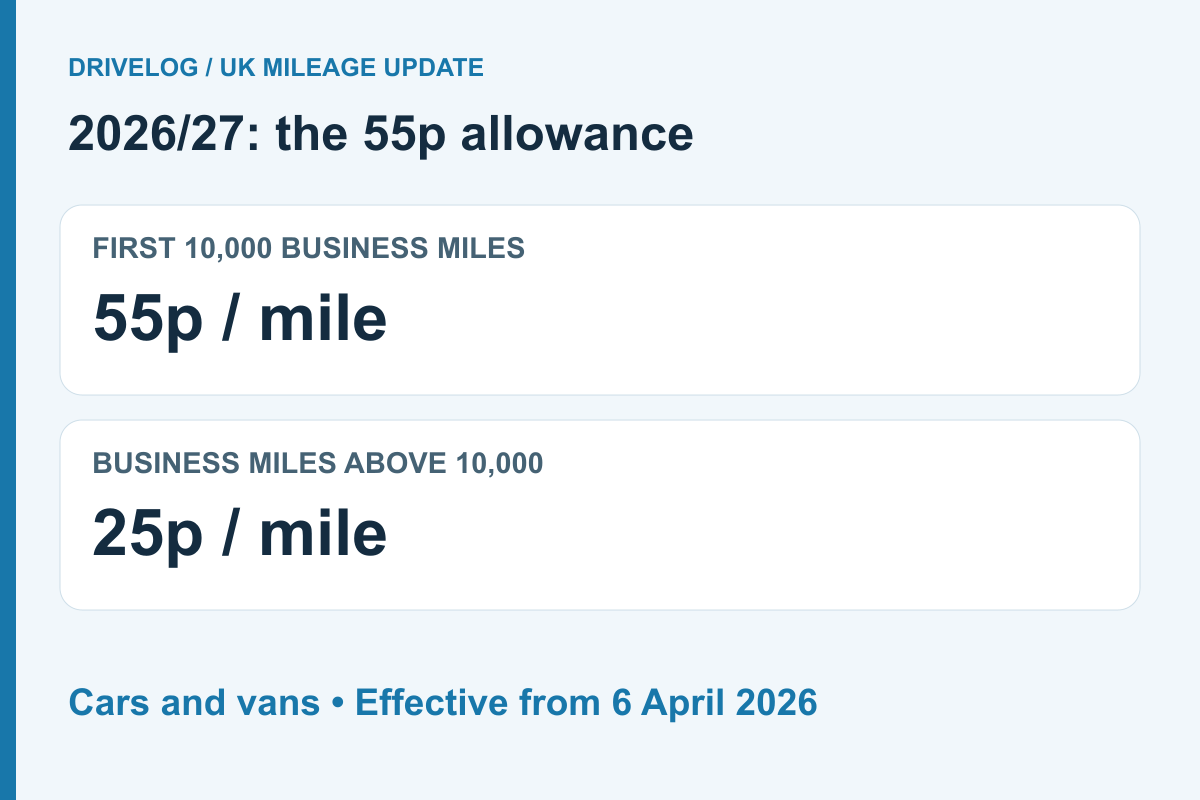
HMRC’s approved car and van mileage amount for 2026/27 is now 55p per mile for the first 10,000 business miles, then 25p. The government announced the increase on 21 May 2026 and backdated it to 6 April 2026.
If you logged journeys or received payments at 45p earlier in this tax year, review how the change affects your calculation. Keep the original trip records and payments; do not assume every difference becomes a cash refund.
The main HMRC mileage rate guide contains the full vehicle-rate table and annual examples. This article focuses on what to do after the increase.
Why this was more than an annual refresh
This was the first AMAP increase since 2011, according to the House of Commons Library. These rates are policy decisions rather than automatically indexed annual allowances.
HMRC’s policy paper explains that the measure responded to elevated fuel prices. The first-tier increase is 10p per mile. The 25p rate beyond 10,000 miles remains unchanged, as do the motorcycle and bicycle AMAP rates.
Which journeys should you review?
Start with business journeys dated 6 April 2026 onwards, including those before the May announcement. Do not start the higher rate only from the day you heard about it.
Check three items together:
- The date and business purpose of each journey.
- Your cumulative business mileage for the tax year and relevant vehicle type.
- The amount your employer actually reimbursed, if you are an employee.
The 10,000-mile threshold is annual. It does not restart in May or every time you submit an expense claim. Keep a running total so you can identify which mileage belongs above the threshold.
Record and classify business journeys with DriveLog, then retain the records supporting your claim.
Employees: what if your employer still pays 45p?
The approved rate sets the tax treatment; it does not require your employer to increase its reimbursement. Ask payroll whether the employer has changed its policy or will make a top-up payment.
If it pays less than the approved amount, you may qualify for Mileage Allowance Relief on the difference. HMRC’s employee vehicle-expense guidance explains how to subtract the reimbursement and claim through the appropriate route. If you file Self Assessment, claim through your return.
Example: 8,000 business miles, all reimbursed at 45p
Assume the journeys qualify, fall in 2026/27, and your employer makes no further payment:
- Approved amount: 8,000 × £0.55 = £4,400.
- Employer payment: 8,000 × £0.45 = £3,600.
- Difference eligible for relief: £800.
- At a 20% marginal tax rate, the illustrative tax saving is £160.
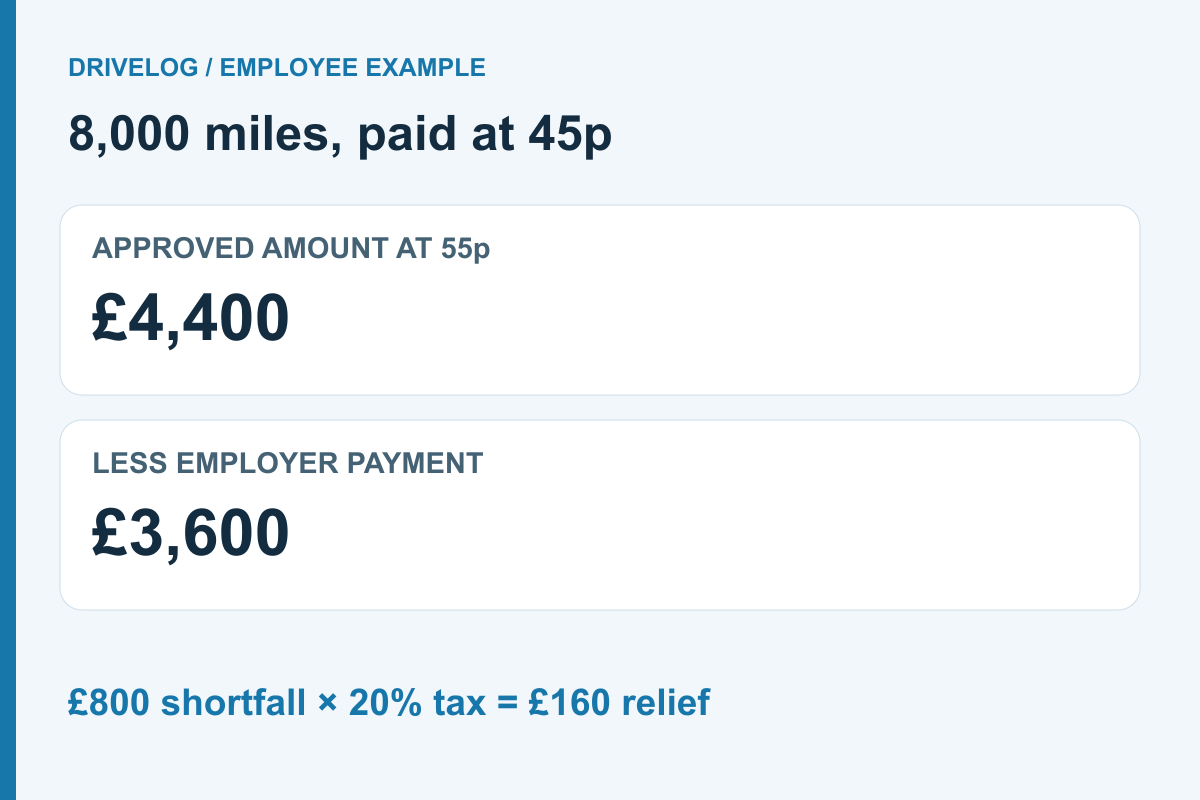
The £800 is not itself the refund. Your tax position determines the relief. If the employer later pays the full £800 shortfall, that amount no longer remains available for an additional relief claim.
Sole traders: review the expense calculation
For eligible sole traders using simplified vehicle expenses, the updated car and goods-vehicle rates also apply in 2026/27. You deduct the calculated expense from business income; you do not treat yourself as an employee receiving a mileage reimbursement.
For 8,000 qualifying miles, the expense is £4,400 rather than £3,600. If you already use actual vehicle costs, the announcement does not by itself let you switch methods. Check the vehicle’s eligibility and existing tax treatment first.
Keep the original mileage log, the revised calculation and any earlier version together. That gives you a clear explanation if your bookkeeping estimate changes.
Keep the previous tax year separate
The 2025/26 tax year ended on 5 April 2026. Its first-tier rate stays at 45p, even when you file that return after the announcement. Use our 2025/26 Self Assessment mileage checklist before the 31 January 2027 online filing deadline.
For current-year records, save a monthly summary and check reimbursements against your business-trip totals. Get DriveLog for iPhone to make everyday trip recording simpler.
Questions about retrospective claims
Does my employer have to pay 55p?
No. The approved amount governs tax treatment, not a compulsory reimbursement rate. Ask your employer about its policy; tax relief may be available on an eligible shortfall.
Is the increase effective from May or April?
It was announced on 21 May 2026 but applies retrospectively from 6 April 2026, the start of the 2026/27 tax year.
Can I use 55p on my 2025/26 tax return?
No. Keep 45p for the first 10,000 qualifying car or van business miles in 2025/26, then 25p. The 55p first-tier rate applies from 2026/27.