US mileage updates
IRS Midyear Mileage Rate Increase: Calculate Your 2026 Deduction
October 2, 2026 • 4 min read
Checked against IRS sources on October 2, 2026.
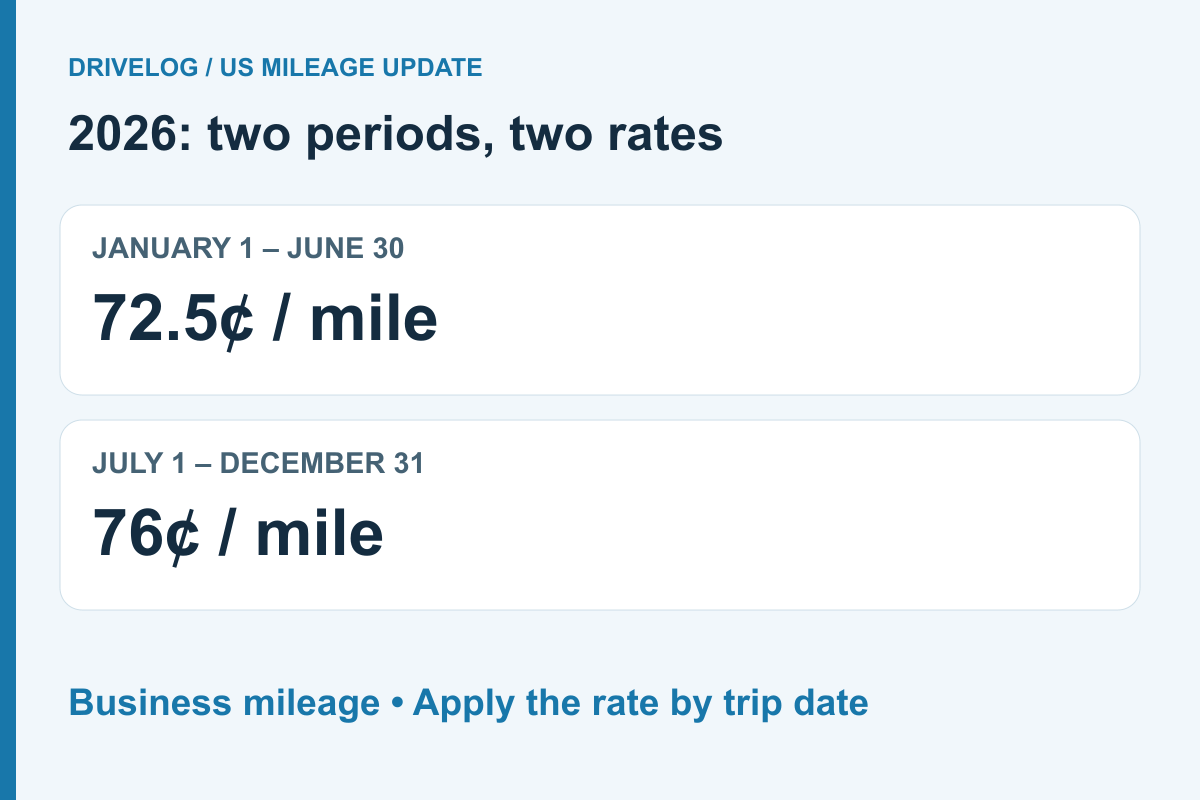
The IRS increased the business mileage rate from 72.5¢ to 76¢ per mile for trips from July 1, 2026. If you drove for business in both halves of the year, calculate two subtotals. Applying either rate to your entire annual mileage gives the wrong result.
This article explains how to adjust your records and calculation. For eligibility, medical and charitable rates, and logging requirements, use the complete IRS mileage rate 2026 guide.
Keep dated business-trip records with DriveLog on iPhone.
Why did the rate change halfway through the year?
The IRS cites increased fuel prices in Announcement 2026-11, which modifies the initial 2026 rates. The revision appears in the bulletin dated July 13 and takes effect from July 1.
This is an exceptional adjustment within the year. The normal annual update had already taken effect in January. The IRS historical table also shows split-year rates in 2022 and 2011, so checking only once each December can miss a change.
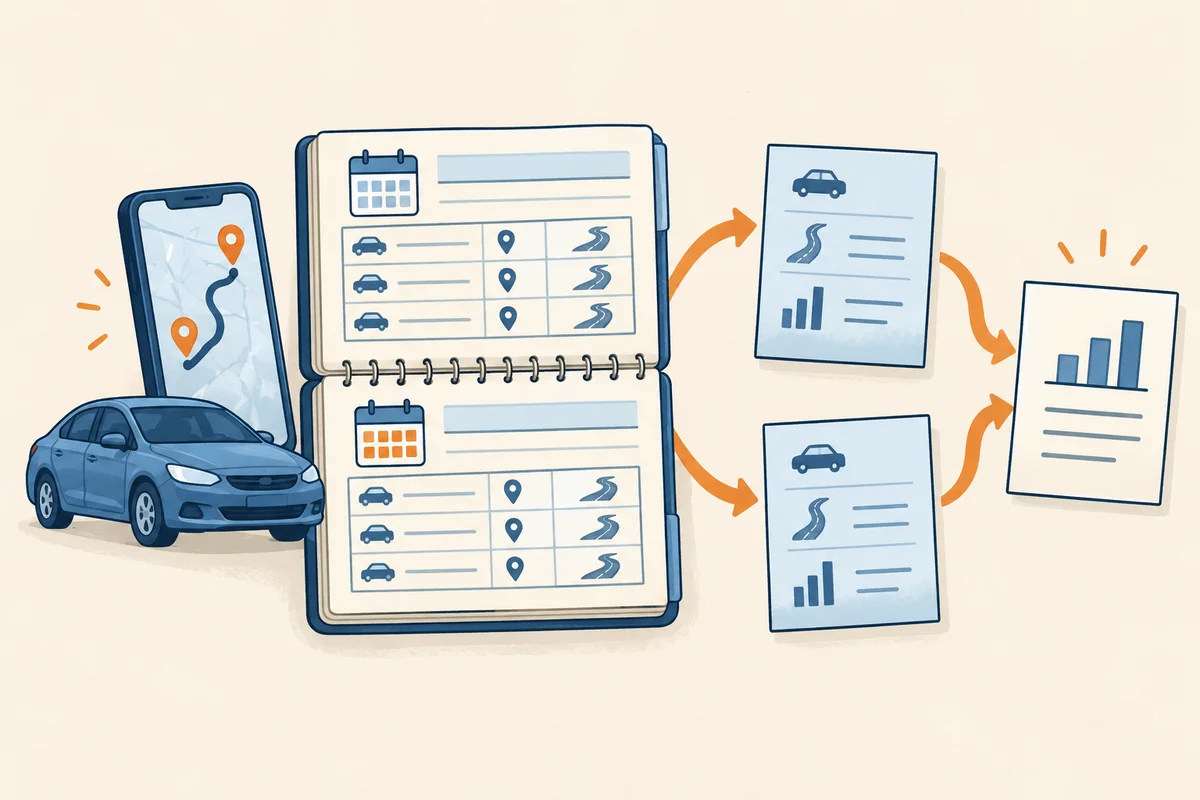
Divide your log by trip date
Start with the dated journeys, rather than an annual mileage estimate:
- Separate qualifying business trips from personal driving and ordinary commuting.
- Total business miles from January 1 through June 30, 2026.
- Total business miles from July 1 through December 31, 2026.
- Keep both subtotals alongside the individual journeys and their business purposes.
A June 30 business trip belongs in the first period. A July 1 trip belongs in the second. Preparing your return after July does not move earlier trips into the higher-rate period.
If you are reviewing your log before December 31, label the result as year-to-date. Add subsequent trips to the appropriate period before preparing the final annual total.
Worked example: 12,000 business miles
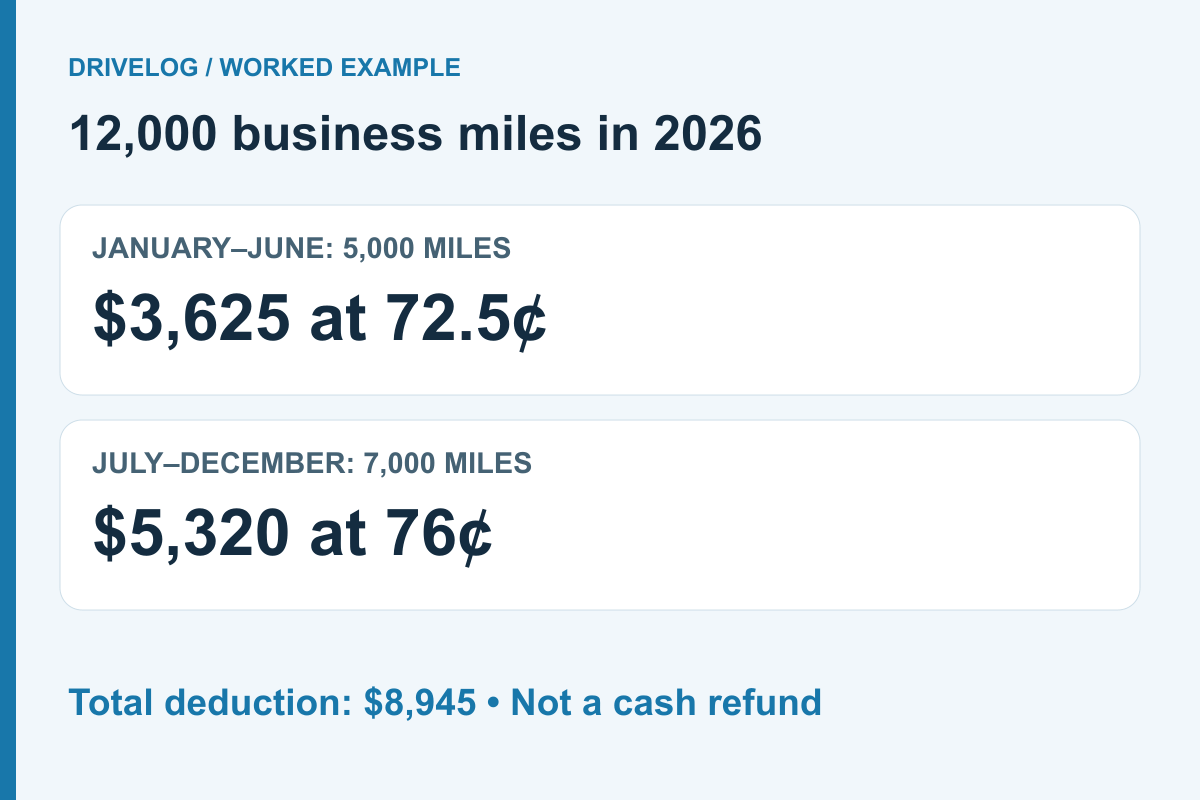
Suppose your log contains 5,000 business miles in January–June and 7,000 in July–December:
- First period: 5,000 × $0.725 = $3,625.
- Second period: 7,000 × $0.76 = $5,320.
- Combined deduction: $3,625 + $5,320 = $8,945.
Using the original rate for all 12,000 miles would produce $8,700, understating this example by $245. Applying 76¢ throughout would produce $9,120, overstating it by $175.
Do not average the two rates and multiply by total mileage unless the mileage in each period is identical. Equal-length calendar periods do not mean you drove equal distances. These figures illustrate a deduction from taxable income, not a cash refund.
Review reports you prepared using the old rate
Keep the original trip dates and distances. Recalculate the dollar value of the July–December subtotal, then compare the revised result with your earlier report. Save enough detail to explain the difference.
If a spreadsheet has one cell for the annual rate, give each period its own mileage and rate cells. In a calculator, look for separate periods or a custom-rate input; otherwise perform the two multiplications yourself. Changing every 2026 journey to 76¢ would overwrite the valid first-half treatment.
For reimbursement arrangements, check with payroll before adjusting payments. The IRS announcement has specific conditions involving both the payment date and the date of the employee’s transportation expense. A tax deduction calculation and an employer’s reimbursement policy are different questions.
Make the next review easier
Save a monthly mileage summary, retain the underlying journeys, and note which official rate you used. A dated log makes a midyear change manageable because you can recalculate amounts without reconstructing where you drove.
Our iPhone mileage tracking guide explains the everyday recording workflow. Download DriveLog to automatically capture trips and review their business or personal classification.
Questions about the July change
Can I use 76¢ for trips before July 1?
No. For 2026 business mileage, use 72.5¢ for January–June and 76¢ for July–December. The higher rate does not replace the first-half rate.
Do I need to change the miles in my log?
No. Keep the actual trip dates, distances and business purposes. Recalculate the dollar amounts using the rate for each period.
Does the increase make personal trips deductible?
No. A higher rate changes the calculation for qualifying mileage. It does not turn commuting or other personal driving into business travel.