Product
CRA Mileage Rate 2026: Canada KM Official Rates ($0.73 cents per km)
November 30, 2025 • 10 min read
Status (January 15, 2026): The Government of Canada announced the official 2026 automobile allowance rates on January 14, 2026. The prescribed rates are $0.73 per kilometre for the first 5,000 business kilometres in the provinces and $0.67 per kilometre for additional kilometres. For the territories (Yukon, Northwest Territories and Nunavut), the rates are $0.77 and $0.71 per kilometre.
Quick answer: 2026 CRA mileage rate
As of January 15, 2026, the official 2026 CRA mileage rate (prescribed automobile allowance) is $0.73 per kilometre for the first 5,000 business kilometres in the provinces and $0.67 per kilometre for any additional kilometres. For the territories, the rates are $0.77 and $0.71 per kilometre.
This guide uses the official 2026 rates announced on January 14, 2026:
- 2026 rate for the first 5,000 business kilometres in the provinces: $0.73 per kilometre
- 2026 rate for additional business kilometres above 5,000 in the provinces: $0.67 per kilometre
- 2026 rate for the first 5,000 business kilometres in the territories: $0.77 per kilometre
- 2026 rate for additional business kilometres above 5,000 in the territories: $0.71 per kilometre
These official rates help determine reasonable allowances and support tax-exempt reimbursements when proper records are kept.
Calculate Your 2026 Deduction → — enter your business kilometres and see a 2026 mileage amount based on the official rates above.
On this page
- Quick answer: 2026 CRA mileage rate
- What is the CRA mileage rate?
- Example using the 2026 official rate
- 2026 CRA mileage rate: official rates
- How to calculate reimbursements using CRA km rates
- What counts as business kilometres?
- How employees use the mileage rate
- How self-employed Canadians use CRA km rates
- Practical tips for 2026
- CRA mileage log requirements and template
- FAQ: 2026 CRA mileage rate
What is the CRA mileage rate for 2026?
Each year, the CRA publishes prescribed per-kilometre amounts that are used as a reasonable allowance for business use of a personal vehicle. Many people refer to these amounts as the CRA mileage rate.
These rates are typically used when:
- Employers pay a per-kilometre allowance to employees who use their own vehicle for work travel
- Self-employed individuals and small business owners work out the value of business kilometres driven
Instead of tracking every fuel, maintenance, insurance and depreciation receipt, some taxpayers rely on the per-kilometre allowance as a simplified way to value each business kilometre. This approach is only acceptable if you keep a detailed, timely mileage log that can be produced if the CRA asks questions.

When was the 2026 CRA mileage rate announced?
The Government of Canada announced the 2026 prescribed automobile allowance rates on January 14, 2026. The new amounts apply to travel from January 1, 2026.
- Announcement date: January 14, 2026
- Effective date: January 1, 2026
- Where published: Government of Canada news release on the 2026 automobile deduction limits and expense benefit rates
- Who it affects: employees receiving per-kilometre vehicle allowances, self-employed individuals, small business owners and other taxpayers relying on CRA mileage rates for 2026
2026 CRA mileage rate: official rates
The official 2026 prescribed rates are $0.73 per kilometre for the first 5,000 business kilometres in the provinces and $0.67 per kilometre for additional kilometres. For the territories (Yukon, Northwest Territories and Nunavut), the rates are $0.77 and $0.71 per kilometre.
Compared with 2025, the provincial rates increased by $0.01 per kilometre for both tiers. The territory supplement remains $0.04 per kilometre.
Even with the official rates set, you still need a contemporaneous mileage log to substantiate business kilometres.
6-year CRA mileage rate history (2021–2026)
For context, the table below shows the official CRA prescribed automobile allowance rates for the provinces over the last six years:
| Year | First 5,000 km (provinces) | Additional km (provinces) |
|---|---|---|
| 2026 | $0.73 per km | $0.67 per km |
| 2025 | $0.72 per km | $0.66 per km |
| 2024 | $0.70 per km | $0.64 per km |
| 2023 | $0.68 per km | $0.62 per km |
| 2022 | $0.61 per km | $0.55 per km |
| 2021 | $0.59 per km | $0.53 per km |
For travel in the territories (Yukon, Northwest Territories and Nunavut), the CRA has generally added an extra $0.04 per kilometre to these provincial rates over the same period.
With the 2026 rates now published, use the official amounts above for 2026 planning and reimbursement policies.
How to calculate reimbursements using CRA km rates
Whether you are an employee receiving a per-kilometre allowance or a self-employed person working out vehicle expenses, the basic calculation using CRA km rates follows the same pattern:
- Record each business trip in kilometres.
- Add up your total business kilometres for the year.
- Apply $0.73 per kilometre to the first 5,000 business kilometres.
- Apply $0.67 per kilometre to business kilometres in excess of 5,000.
- If the travel is in the territories, use $0.77 and $0.71 per kilometre instead.
Example: self-employed consultant in Ontario
A consultant based in Ontario drives 12,000 business kilometres in the year and applies the official 2026 CRA mileage rates to those kilometres. The mileage amount would be calculated along these lines:
- First 5,000 km × $0.73 = $3,650
- Next 7,000 km × $0.67 = $4,690
In this example, the total mileage amount for the year would be $8,340, based on the official rates above. The key point is that this calculation only works if the 12,000 business kilometres are supported by a clear, contemporaneous mileage log.
What counts as business kilometres?
For CRA purposes, only business kilometres are relevant when applying the mileage rate or working out the business-use percentage of a vehicle. Personal driving is not deductible.
Typical examples of business kilometres include:
- Travel from a regular workplace to a client’s office or job site
- Travel between multiple client locations in the same day
- Trips to suppliers, equipment depots, or delivery points for business reasons
- Travel to networking events, trade shows, or industry conferences related to your work
Routine commuting from home to a primary workplace is generally personal, even if you take calls or answer emails on the way. The rules can be nuanced for people who work from home or have more than one regular workplace, so it is sensible to review CRA guidance or speak with a tax advisor if a trip seems borderline.

How employees use the CRA mileage rate
Employees who use their own vehicle for work often receive a per-kilometre allowance from their employer. If that allowance is based on a reasonable rate and the employee pays their own vehicle expenses, the allowance may be non-taxable.
Many employers benchmark their allowance against the CRA mileage rate for the year. To stay aligned with CRA expectations, employees should generally:
- Record each work-related trip with the date, destination, purpose and kilometres driven
- Submit mileage records on a regular schedule so payments are tied to actual business use
- Keep a clear separation between personal and business kilometres in case records are reviewed
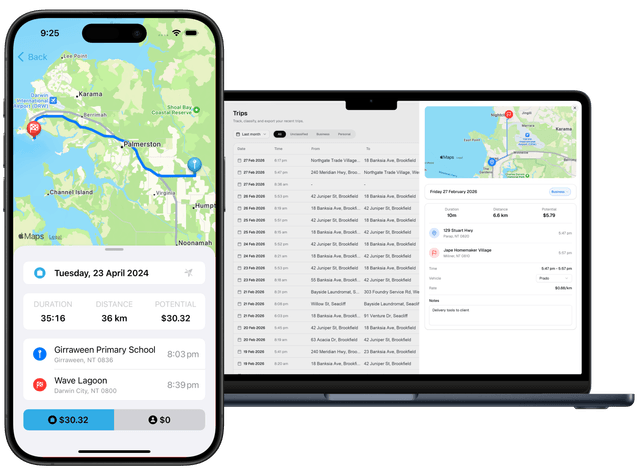
Using an app such as DriveLog helps keep these records up to date throughout the year, rather than trying to rebuild missing trips at tax time.
How self-employed Canadians use CRA km rates
Self-employed individuals, freelancers and owners of small corporations generally have two main ways to deal with vehicle costs for tax purposes:
- Claiming actual vehicle expenses in detail and applying a business-use percentage
- Using the CRA per-kilometre allowance as a simplified way to value each business kilometre, or as a benchmark for reasonableness
In both cases, the CRA expects the number of business kilometres to be backed by a consistent, verifiable log. Guidance repeatedly stresses the importance of recording start and end odometer readings, dates and trip purposes.
With the 2026 mileage rate now set, maintaining clear documentation remains essential. A well-organized mileage log supports the deduction in the event of a CRA review and makes year-end work easier for both the taxpayer and their accountant.
Practical tips for the 2026 CRA km rate
The following steps can help you prepare for the 2026 CRA mileage rate and keep accurate records all year:
- On January 1, record your vehicle’s odometer reading to establish a clear starting point for the year.
- Log trips promptly. Recording a trip right after it happens is more reliable than trying to remember a week’s worth of driving.
- Write down the business purpose for each trip. A short note such as “client meeting – downtown office” is usually enough.
- Save supporting documents, including digital receipts and calendar entries, especially for longer or higher-value trips.
- Now that the CRA rates for 2026 are published, update your spreadsheets, accounting software or internal policies to reflect the new amounts.
For advice on your specific situation, consult a Canadian tax professional or review official CRA publications.
CRA mileage log requirements and template
Even with the 2026 CRA mileage rate set, you still need to meet the CRA’s mileage log requirements to support any deduction or reimbursement. The CRA expects your records to separate business and personal use and to document the key details of each business trip.
In practice, a basic mileage log or spreadsheet should record:
- Date of the trip
- Starting location and destination
- Business purpose of the trip
- Odometer reading at the start and end of the trip
- Total business kilometres driven
These elements can be used to create a simple CRA-style mileage log template in Excel, Google Sheets or another tool you prefer, and then updated throughout the year.
The practical difficulty is maintaining the habit of recording every business trip. A mileage log app that aligns with CRA record-keeping expectations, such as DriveLog, lets you track business kilometres on your phone instead of relying on paper logbooks or manual spreadsheets.
If you want a practical setup flow, use our iPhone mileage log guide.
If you also need information about the United States standard mileage rate, a dedicated guide to the 2026 IRS mileage rate provides the corresponding IRS perspective on mileage deductions.
FAQ: 2026 CRA mileage rate
When were the 2026 CRA mileage rates announced?
The Government of Canada announced the 2026 prescribed automobile allowance rates on January 14, 2026, and they apply to travel from January 1, 2026.
What is the official 2026 CRA mileage rate?
For the provinces, the 2026 rate is $0.73 per kilometre for the first 5,000 business kilometres and $0.67 per kilometre for additional kilometres. For the territories (Yukon, Northwest Territories and Nunavut), the rates are $0.77 and $0.71 per kilometre.
Do I have to use the CRA mileage rate, or can I claim actual expenses?
You are not required to use the per-kilometre allowance. Many Canadians do so because it is straightforward and widely accepted when applied correctly. In some situations, especially if your vehicle costs are unusually high, claiming actual expenses may give a different result. The better approach depends on your circumstances, so consider speaking with a tax professional before changing methods.
Do I need to keep paper records?
No. The CRA accepts electronic mileage records as long as they capture the same information as a paper log, such as dates, destinations, kilometres and the business purpose of each trip. Using an app like DriveLog lets you keep organised digital records on your phone instead of relying on a paper notebook.